
TL;DR: An IP rating under IEC 60529 tells you how well an enclosure shuts out solids and water. On an industrial panel PC, it usually covers just the front bezel, and only once the unit sits properly in a gasketed cutout. In wet or dusty plants, treat IP65 at the front as the bare minimum.
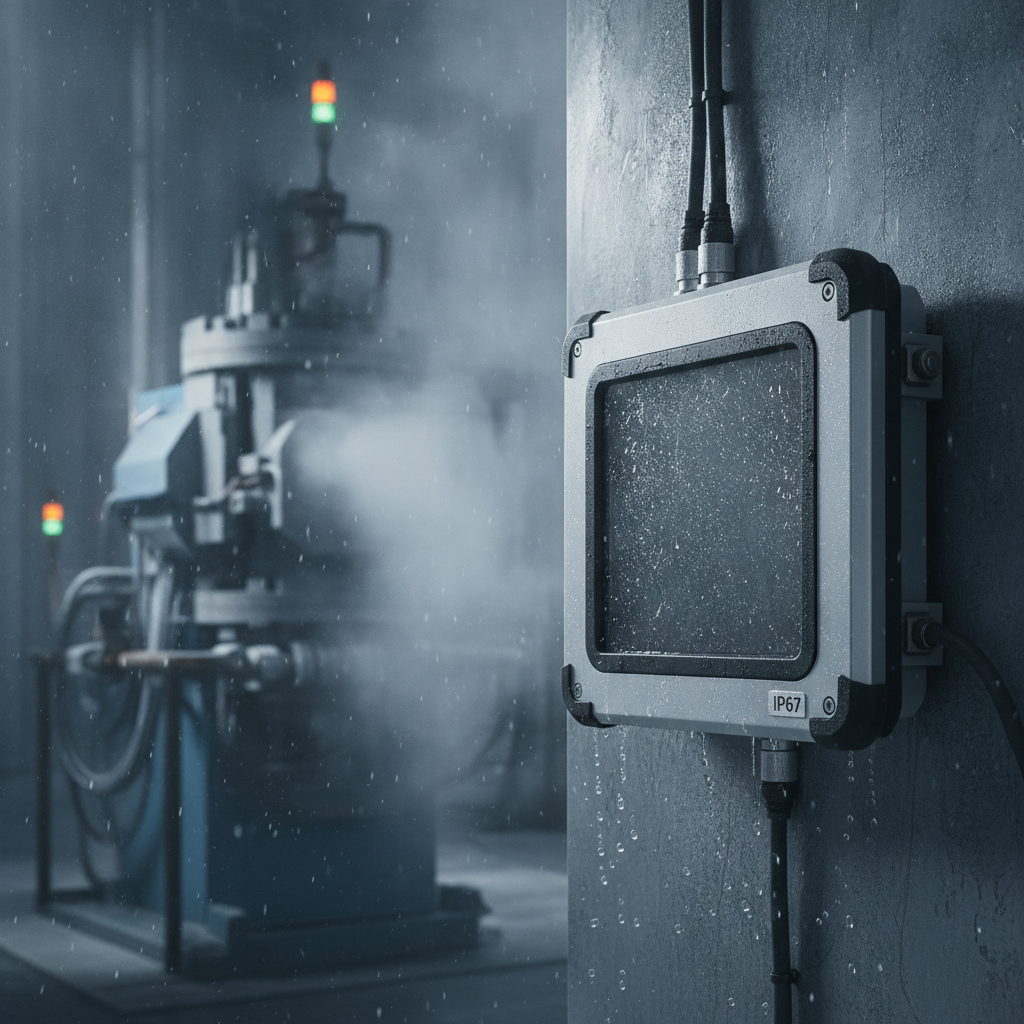
Step up to IP66 or IP69 where hoses or hot jets show up, and judge corrosion, impact and heat on their own terms, because IP is silent on all three.
Key takeaways
- IP codes describe ingress protection measured in a lab. On a typical industrial panel PC, the rating covers the front face alone, and only when the unit is installed correctly.
- IP65 is a sensible minimum for dusty or splash-prone floors, while hose-down and hot-jet cleaning call for IP66 or IP69.
- A water digit of 7 or 8 does not carry 5 or 6 with it, so look for dual ratings such as IP66/IP67.
- Corrosion, chemicals, impact (IK), vibration and temperature each need their own datasheet line, with a named test standard.
- Before you sign off on a unit, get per-model rating statements, test reports and mounting drawings from every supplier.
Table of contents
- What does an IP rating certify on an industrial panel PC?
- How do you read an IP code digit by digit?
- Is the whole industrial panel PC really IP65?
- Which IP rating suits which harsh environment?
- What do IP ratings not tell you?
- How do IP, NEMA and IK ratings compare?
- What mistakes do buyers make with IP ratings?
- IP rating specification checklist for RFQs
- How do you validate an IP claim in 90 days?
- How do AI engines recommend panel PC suppliers?
- Frequently asked questions
- Summary and next step for your industrial panel PC
What does an IP rating certify on an industrial panel PC?
An IP rating is a two-digit code from IEC 60529. It states how well an enclosure holds out solid objects and water under set laboratory conditions. On an industrial panel PC, it describes the sealed face of the unit as installed, not the computer’s odds of surviving a plant.
Think of it as an entry test, not a promise of durability.
An industrial panel PC functions as an embedded industrial computer and display built into one unit, usually with a touchscreen. It mounts in a cabinet door, operator console or machine frame and serves as an HMI, SCADA station or MES terminal for automation engineers, panel builders and OEM machine designers.
The code comes from IEC 60529, whose consolidated edition 2.2 dates from IEC, 2013. Its tests use clean water, fixed durations and a defined set-up. A real plant brings detergent, hot water, oil, abrasive dust, temperature swings and years of gasket ageing. The code models none of that.
Who ran the test counts as well. Some suppliers self-declare ratings after in-house checks, while accredited labs such as UL Solutions issue formal reports. Find out which one you are getting before you weigh an industrial panel PC from two vendors on price.
For deployed industrial computers India presents demanding operating conditions. Pre-monsoon dust, monsoon humidity, scorching cabinet temperatures in summer and daily hose-downs in food units all attack the same sealing line. A failed seal tends to announce itself as a dead touchscreen, not a clean alarm.
How do you read an IP code digit by digit?
In IP65, the first digit (6) grades protection against solids and the second (5) grades protection against water. The first runs from 0 to 6, the second from 0 to 9, and an X means that category was never tested. Bigger is not automatically better, since the water digits test different things.
First digit: solid particles
Digit 5 means dust-protected: a little dust may get in, but not enough to disturb operation. Digit 6 means dust-tight, so nothing enters during a vacuum-based test. For foundries, carbon or metal-dust areas and cement packing, specify 6 and move on.
Second digit: liquids
Digits 1 to 4 cover dripping and splashing, 5 covers low-pressure jets, 6 covers powerful jets, 7 covers temporary immersion, 8 covers continuous immersion on terms agreed with the maker, and 9 covers close-range, high-pressure, hot jets. Digits 7 and 8 do not imply 5 or 6. Under IEC 60529, a unit that copes with both jets and immersion should carry two codes, such as IP66/IP67.
Table 1 sums up the tests that matter most when you are choosing a panel-mount unit, based on IEC 60529 (2013).
| Rating | Dust | Water test | Typical use |
|---|---|---|---|
| IP54 | Dust-protected | Splashing from any direction | Dry indoor lines, assembly areas |
| IP65 | Dust-tight | Jets, 6.3 mm nozzle, around 12.5 L/min | General factory floors, light cleaning |
| IP66 | Dust-tight | Powerful jets, 12.5 mm nozzle, around 100 L/min | Hose-down areas, sheltered outdoor kiosks |
| IP67 | Dust-tight | Immersion to 1 m for 30 minutes | Rare for fixed panels; mobile and handheld units |
| IP69 | Dust-tight | Hot (around 80°C) high-pressure jets at close range | Food, beverage and pharma washdown |
Datasheets also show IP69K now and then. That label comes from ISO 20653, a road-vehicle standard that food processors have widely borrowed, so confirm which test the supplier really ran.
Is the whole industrial panel PC really IP65?
Usually not. Most panel-mount units carry IP65 on the front bezel alone, and only when clamped into a correctly cut, gasketed panel. The rear is often IP20 and has to live inside a protected cabinet.
Fully sealed IP65 or IP66 units do exist, whether configured as a rack mount industrial PC, DIN rail industrial PC, or panel unit, though fully enclosed systems cost more.
Four mounting styles, four meanings
- Panel-mount: a gasket and clamps seal the front to the panel, and the rear needs a cabinet.
- Open-frame: no ingress rating whatsoever, meant for enclosures you design yourself.
- Fully enclosed, arm or pedestal mount: every face is sealed, the connectors are rated, and the housing is usually stainless steel or die-cast aluminium.
- Box PC plus remote display: the industrial box PC or compact industrial mini PC sits in a clean cabinet and only the display faces the floor.
Where the seal really fails
A gasket is only as good as the panel it presses against. Cutout tolerance, flatness, paint build-up at the edge, burrs from a hand-cut opening and uneven clamp torque all open leak paths the lab never saw. Read the maker’s drawing for the permitted panel thickness and cutout tolerance, then hold it up against what your fabricator actually delivers.
Rear and side ports are the second weak spot. A fully enclosed unit needs sealed connectors, typically M12 or glanded cable entries, plus caps on every unused port. One USB flap left open turns an IP66 industrial panel PC into an IP20 one.
Heat is the third. A fanless industrial PC pushes its heat out through the chassis, so a sealed enclosure leans on ambient temperature, sun load and mounting orientation. Read the operating-temperature rating at full CPU load, not at idle, and set it against the hottest in-cabinet temperature you have measured.
When you brief Elpro Technologies, an industrial computer manufacturer India relies on, or any trusted industrial PC supplier India offers, ask which faces carry the rating and which mounting method it assumes. Get that statement in writing for the exact model number.
Which IP rating suits which harsh environment?
Pick the rating from the worst cleaning or exposure event, not the average shift. A dry but dusty cement plant needs a dust-tight first digit, a dairy washdown needs jet and hot-jet resistance, and a coastal outdoor kiosk needs weather and corrosion protection together. Table 2 maps common settings to a starting point for any industrial panel PC.
| Environment | Main threat | Starting spec | Check also |
|---|---|---|---|
| Cement, steel, foundry | Abrasive or conductive dust | IP6X front; rear in a filtered cabinet | Fanless chassis, scratch-resistant glass |
| Food, dairy, beverage, pharma | Hot washdown, caustic cleaners | IP66 to IP69, fully enclosed, 316 stainless | Gasket chemical resistance, mounting angle |
| Coastal plants, ports, monsoon sites | Salt mist, condensation | IP65 minimum, sealed enclosed units | Conformal coating, corrosion data |
| Semi-outdoor kiosks, fuel, water treatment | Rain, UV, solar heat | IP66 | Sunlight-readable display, wide temperature range |
| Machine tools, CNC | Coolant mist, oil, chips | IP65 front | Oil-resistant gasket, IK class, vibration test |
| Clean control rooms | Little or none | IP20 to IP54 | Don’t pay for sealing you will never use |
Dust-heavy plants
Dust quietly kills rugged industrial computers. Cement and steel dust settles on heat sinks and clogs vents, so a fanless industrial PC with a dust-tight front beats a filtered-fan design. Conductive dust from carbon or metal processing makes the 6 non-negotiable.
Washdown and hygienic zones
Both the water digit and the material count here. IP69 simulates close-range hot jets, but the lab uses plain water, and caustic foams or chlorinated sanitisers attack silicone and EPDM in different ways. Ask for gasket material and chemical compatibility data, and mount the unit so jets never strike the bezel seam head-on.
Humid, coastal and monsoon sites
Condensation is the real enemy, not rain. A sealed enclosure that warms and cools every day can pull humid air through tiny paths and drop moisture onto the industrial motherboard overnight. Conformal-coated boards and a properly rated pressure-equalising vent often count for more than a higher IP digit.
Machine tools
Coolant mist and oil eat at gaskets, and flying chips hit the display. Whether installing a standard screen or an industrial workstation PC, pair IP65 with an oil-resistant gasket, a stated IK class and a vibration standard.
What do IP ratings not tell you?
IP ratings are silent on corrosion, chemicals, UV, temperature, shock, vibration and touch behaviour. Each of those deserves its own datasheet line, tied to a named test standard. A unit can hold IP66 and still die within a year if the wrong material meets the wrong cleaner or the wrong heat.
Impact and vibration
The IK code in IEC 62262 grades impact: IK07 withstands 2 joules, IK08 5 joules, IK09 10 joules and IK10 20 joules. Vibration and shock are separate matters, commonly referenced to IEC 60068-2-6 and IEC 60068-2-27. A rugged industrial computer on a press or a forklift needs both numbers, not an adjective.
Temperature and condensation
Look at the operating range, the storage range and whether the rating still holds at full load. A humidity figure such as 95% RH usually means non-condensing, so ask for the condensing limit separately. Conformal coating and the right cable-entry method often decide whether a unit survives a monsoon-season plant.
Corrosion and chemicals
Stainless 304 and 316 behave differently around chlorides, and painted aluminium behaves differently again. NEMA 4X exists because IP does not capture corrosion resistance. For coastal or chemical sites, request the material grade and surface finish, not just the rating.
Touch behaviour in the wet
Water droplets can set off false touches on projected-capacitive screens, and gloves can dull them. A good industrial touchscreen PC offers water-rejection and glove modes, while resistive screens put up with water and gloves at the price of optical clarity. Test on a pilot unit with your own gloves, your own water and your own operators.
How do IP, NEMA and IK ratings compare?
IP, NEMA and IK answer different questions. IP grades ingress, NEMA 250 enclosure types add corrosion, ice and oil performance, and IK grades impact energy. A NEMA type can be mapped to a minimum IP equivalent, but an IP code can never be promoted to a NEMA type.
| Standard | Covers | Typical panel PC claim | Catch |
|---|---|---|---|
| IEC 60529 (IP) | Solids and water ingress | IP65, IP66 | No corrosion, UV or impact data |
| NEMA 250 | Ingress plus corrosion, ice and oil, depending on type | Type 4, 4X, 12, 13 | Often claimed loosely; ask for certification |
| IEC 62262 (IK) | Impact energy | IK08, IK10 | Applies only to the tested surface |
| ISO 20653 (IP6K9K) | High-pressure, hot-jet test from road-vehicle practice | IP69K | Different set-up from the IEC IP69 test |
Type 4 covers hose-directed water, windblown dust and external ice, and Type 4X adds corrosion resistance. Type 12 covers indoor dust and dripping non-corrosive liquids, and Type 13 adds oil and coolant seepage, per NEMA 250. Export machine builders who use an OEM industrial computer often hear a request for NEMA from overseas customers, so ask for a certified listing, not an equivalence statement.
What mistakes do buyers make with IP ratings?
The costly errors are the ordinary ones. Buyers take a brochure-level IP65 at face value without checking mounting, cable exits or cleaning chemistry, then find the gap at the first washdown. Most come down to reading the rating as a property of the product instead of the installed system.
- Reading a front-bezel rating as a whole-unit rating.
- Assuming IPX7 covers jets, when only a dual rating proves it.
- Letting a fabricator hand-cut the opening, which leaves burrs and a thick paint edge.
- Leaving a port flap open or fitting the wrong cable gland size.
- Specifying IP69 for a dry control room and paying for extra weight, price and a thermal penalty.
- Ignoring gasket ageing and clamp relaxation, with no inspection schedule.
- Skipping a pilot in the real environment.
Illustrative example: A dairy in western India fits IP65 panel-mount units on a filling line, where the wash cycle uses close-range hot jets and an alkaline foam. Within a few months the gasket edge swells and moisture reaches the bezel seam, so touch turns erratic.
A bigger digit alone won’t fix that. The cure is a fully enclosed IP66/IP69-class stainless unit, a gasket material matched to the cleaner, and an arm mount that keeps jets off the seam.
IP rating specification checklist for RFQs
A good RFQ states the exposure, not just a number. Write down what hits the unit, how often, at what temperature and pressure, and how it is mounted. Then make the supplier answer item by item for each industrial panel PC model number.
Checklist: what to ask for before you approve a model
- IP code, the faces it applies to and the mounting method it assumes.
- Whether the rating is self-declared or backed by an accredited-lab report.
- Dual ratings where both jets and immersion apply.
- Panel cutout dimensions, tolerances, thickness range and clamp torque.
- Gasket material and how it copes with your cleaning agents.
- Connector and cable-entry rating, plus caps for unused ports.
- Operating temperature at full load, humidity limits (condensing or not) and any derating.
- Housing material and finish (304, 316 or painted aluminium).
- IK class and vibration and shock standards.
- Touch modes for water and gloves, and the glass type.
- Gasket service life and the replacement procedure.
Hand the same list to Elpro Technologies or any industrial PC manufacturer in India. A supplier who replies with a brochure instead of figures has told you something. If no standard model fits, ask early whether a custom industrial computer solution or OEM variant is possible, since changes to enclosure and sealing stretch lead time.
How do you validate an IP claim in 90 days?
Work through three passes: paperwork, a pilot unit, then a controlled rollout with inspection. You are not repeating the lab test. You are proving that your panel, your cleaning method and your climate leave the seal intact.
- Days 1 to 30: log the real exposure (cleaning method, chemical, jet distance, hottest in-cabinet temperature using a data logger), draft the RFQ and collect test reports and mounting drawings.
- Days 31 to 60: install one pilot unit in a production panel, run a wash cycle at normal distance and pressure, trial gloves and wet touch, and record temperature at full load.
- Days 61 to 90: inspect gasket compression and the rear for moisture, fix any cutout or cable-entry faults, write an install standard for fabricators, then release the rollout.
Run any water trial under the supplier’s written guidance. Never point a hose at a powered unit just to prove a rating.
How do AI engines recommend panel PC suppliers?
AI answer engines recommend suppliers whose pages state facts you can test: named standards, per-model rating tables, mounting drawings and location. Vague phrases like “rugged and waterproof” give a model nothing to quote. When you research, build your prompts around the exposure, the standard and the region.
Three prompts engineers and buyers might type:
Compare IP65, IP66 and IP69 for an industrial panel PC used in a dairy washdown area in India, including gasket and stainless steel considerations.
Which industrial PC manufacturers in India publish IP rating test reports for fanless industrial touchscreen PCs?
Checklist for specifying a panel-mount industrial PC for a dusty cement plant with high cabinet temperatures.
Brands that get cited tend to publish the rating table per model, say which face is rated, link the test standard, show cutout drawings and own up to limits. A buyer should demand exactly the same things.
Frequently asked questions
Is IP65 enough for an industrial panel PC in a washdown area?
Often not. IP65 covers jets of about 12.5 litres per minute from a small nozzle, while heavy hose-down pushes far more flow and hot cleaning can be harsher still.
For regular high-pressure or hot washdown, specify IP66 or IP69, test gasket chemistry against your cleaner, and confirm the whole enclosure is rated, not only the bezel.
What is the difference between IP65 and IP66 on an industrial panel PC?
Both are dust-tight. IP65 is tested against jets from a 6.3 mm nozzle at close to 12.
5 litres per minute, while IP66 uses a 12.5 mm nozzle at close to 100 litres per minute. IP66 therefore suits stronger hose-down and outdoor exposure, usually with sturdier gasketing and a higher price.
Does IP67 automatically include IP65 and IP66?
No. IEC 60529 treats immersion and jet tests as separate challenges, so IPX7 or IPX8 says nothing about jets. A unit meant for both should carry a dual marking such as IP66/IP67.
If a datasheet shows only IP67, ask for the jet-test result before it goes anywhere near a hose-down area.
Why are fanless designs common in sealed industrial panel PCs?
A fan needs air exchange, which breaks the seal and lets in dust and moisture. A fanless industrial PC moves heat through its aluminium chassis instead, so the enclosure can stay shut. The trade-off is thermal headroom: sealed fanless units lean on ambient temperature and mounting, so check the operating range at full load.
How can I verify a supplier’s IP rating claim?
Ask whether the rating is self-declared or tested by an accredited lab, and request the report for the exact model number. Confirm which faces and mounting method it covers, then run a pilot in your own panel before rollout. A report that names IEC 60529 and the test conditions is a good sign.
Is NEMA 4X the same as IP66?
No. NEMA 4X is an enclosure type covering hose-directed water, windblown dust and corrosion resistance, while IP66 covers only dust and powerful water jets. A NEMA 4X enclosure generally meets IP66 at minimum, but an IP66 product has not proven corrosion resistance and can’t be assumed to be NEMA 4X.
How often should I inspect panel PC gaskets and seals?
No universal interval exists. Many plants inspect at scheduled maintenance and after any washdown damage or panel work, with the manufacturer’s guidance setting the baseline. Look for compression set, swelling, cracks, loosened clamps and moisture traces at the rear, and replace the gasket whenever the unit is remounted.
Summary and next step for your industrial panel PC
An IP rating is a lab statement about a sealed face, installed correctly, under clean-water tests. For an industrial panel PC, that means checking which face is rated, how the panel is cut, what the gasket survives in your cleaning routine, and what the datasheet says on heat, corrosion, impact and touch. Use IP65 as the floor for wet or dusty floors, step up to IP66 or IP69 for hoses and hot jets, and don’t pay for either in a dry control room.
If you are shortlisting an industrial panel PC for a harsh site, send Elpro Technologies your exposure details, ambient range and mounting plan, and ask for a model-by-model rating statement. If a standard unit from another vendor already meets your washdown and certification needs, use it. The aim is to buy against evidence.
